Quick Answer
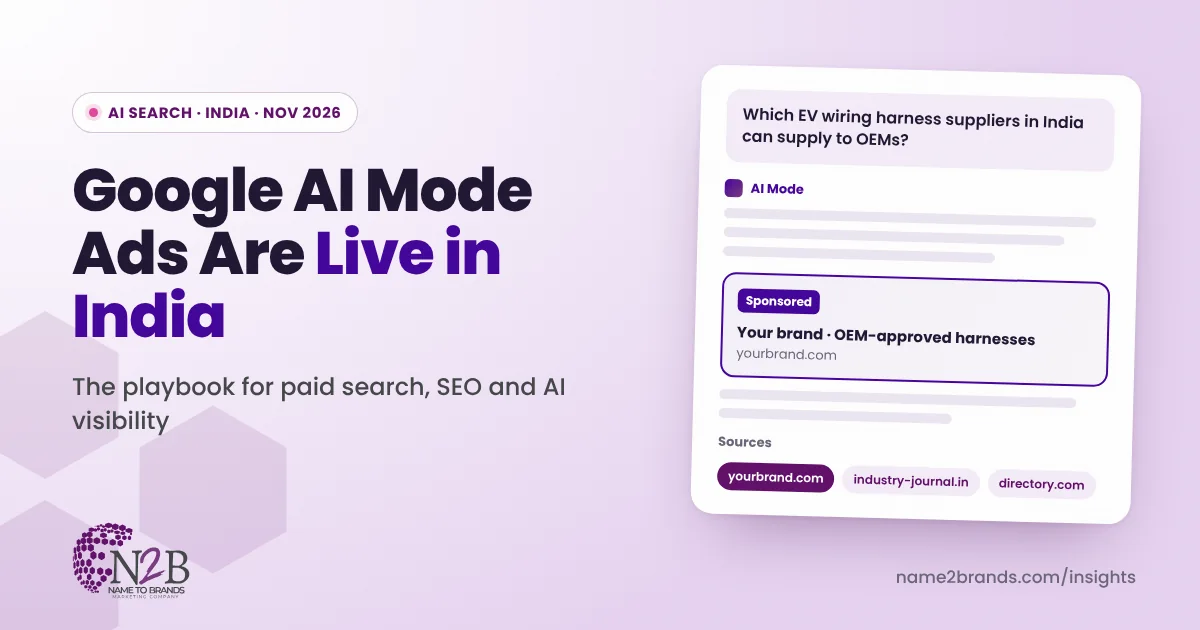
Since 28 October 2026, Google can show ads labelled "Sponsored" inside AI Mode answers in India. Existing Search, Shopping and Performance Max campaigns are eligible automatically, and AI Mode cannot be switched off on its own. To win, tighten match types and negatives, track cost per qualified lead, answer long buyer questions on your pages and keep your brand facts consistent everywhere.
On 28 October 2026, Google started showing ads inside AI Mode, its conversational search experience, in India and nine other countries. For any brand that depends on Google for enquiries, this is the biggest change to the search results page since AI Overviews arrived. Answers are getting longer, organic clicks are getting scarcer, and now paid placements sit inside the answer itself.
This guide explains what changed, how ads in AI Mode work, what the latest click data shows, and the ten steps our SEO and paid search team recommends for Indian B2B, automotive and service brands right now.

What Changed On 28 October 2026
Google announced that it is scaling ads in AI Mode to Australia, Canada, India, Kenya, Malaysia, New Zealand, Nigeria, Pakistan, the Philippines and Singapore, with Brazil, Mexico and the United Kingdom planned for later in the fourth quarter of 2026 (Google Ads & Commerce Blog). Three details in that announcement matter most:
- Ads are labelled "Sponsored" and can appear within or alongside the AI-written answer.
- Questions are much longer. Google says AI Mode queries are on average about three times longer than traditional searches.
- Sponsored product results are clicked about as often as organic ones. Google reports that, in its US data, click-through rates were similar for sponsored and organic product listings inside AI Mode.
In the US, Google has gone a step further with "multiturn" ads that can appear on follow-up questions. That format has not been announced for India yet, but it shows where AI Mode advertising is heading: ads that follow the whole conversation, not just the first question.
How Ads In AI Mode Work
You do not need a new campaign type. According to Google's help documentation, as summarised by PPC Land, these are the rules that matter for advertisers in India:
| Question | Answer |
|---|---|
| Which campaigns can show? | Existing Search, Shopping and Performance Max campaigns are eligible automatically. No new budget or campaign is needed. |
| Which settings reach more AI Mode queries? | AI Max for Search, broad match, Shopping and Performance Max can match the context of the AI answer. Exact and phrase match only show for clearly commercial questions. |
| Can I opt out? | No. AI Mode and AI Overviews cannot be targeted or excluded separately from Search. Negative keywords and brand exclusions still apply. |
| Where are the results reported? | Inside your normal campaign reports. There is no separate AI Mode segment, so you have to read the search terms carefully. |
| Which language? | English only, for now. |
The practical meaning: if you run Google Ads in India, some of your budget may already be spent in AI Mode. Whether that money works depends on your match types, your negatives and how well your landing pages answer long, specific questions.
What The Click Data Says
AI features answer more questions on the results page, so fewer people click through. The direction is clear across independent studies, even if the size varies:
- Ahrefs found that when an AI Overview appears, the top-ranking page now gets a 58% lower click-through rate on average, up from 34.5% in its first study (Ahrefs, December 2025 data).
- A randomised field experiment found AI Overviews cut organic clicks on the affected searches by 38% (Search Engine Journal).
- Seer Interactive saw click-through rates on AI Overview searches bottom out at 1.3% in December 2025 and recover to 2.4% by February 2026 (Search Engine Land). In an earlier study, Seer also found that brands cited inside AI Overviews earned higher organic click-through rates than brands that were not cited (Seer Interactive).

For B2B brands, the bigger shift is who is asking. In G2's March 2026 survey of 1,076 software buyers, about half said they now start their research with an AI chatbot more often than with Google (G2). Responsive's research found that one in four B2B buyers already uses generative AI more than traditional search to research suppliers (Digital Commerce 360). And Forrester notes that buyers use AI as a starting point, then check its answers with peers, experts and the vendors themselves (Digital Commerce 360).
Put together: fewer clicks, more decisions made on the results page, and a shortlist formed before anyone visits your website. Being named in the answer now matters as much as ranking below it.
The Paid Search Playbook: 5 Steps
- Audit your search terms every week. AI Mode queries are long and conversational. Read the search terms report for questions you never targeted, then add negatives for the irrelevant ones and new ad groups for the valuable ones.
- Decide your match strategy on purpose. Broad match and AI Max reach AI Mode's contextual queries; exact and phrase match keep you on clearly commercial searches. For most B2B accounts we recommend a controlled broad-match campaign with tight negatives, running beside your exact-match core.
- Lock down brand safety. Use brand exclusions, account-level negatives and asset pinning where your claims must stay precise, especially in regulated categories such as finance and healthcare.
- Write ads that answer. A person who has just read a detailed AI answer is further down the funnel. Headlines that state a specific capability, price range or proof point beat generic slogans.
- Track to the lead, not the click. With AI Mode results rolled into normal reports, conversion tracking (GA4, enhanced conversions, CRM import) is the only way to know whether this traffic pays. Judge it by cost per qualified lead.
The SEO And GEO Playbook: 5 Steps
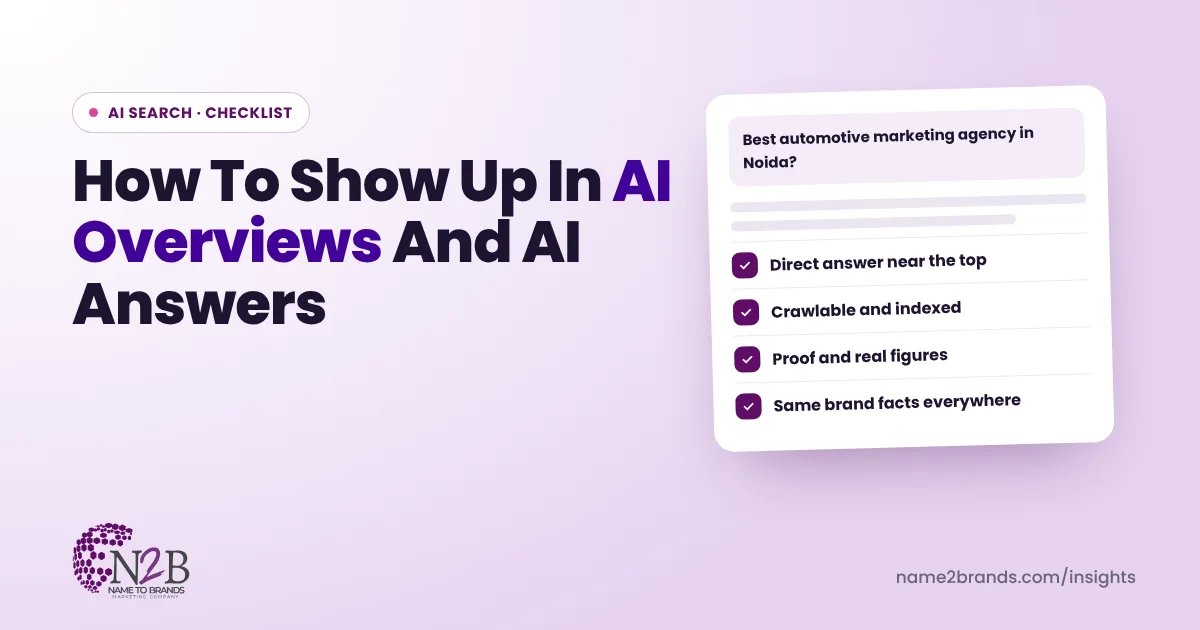
These five steps sit on top of good technical SEO. For the full on-page checklist, see our guide on how to show up in AI Overviews and AI answers.
- Answer the long questions. List the detailed questions buyers ask before they call you, such as specifications, compliance, timelines and comparisons. Give each one a clear, self-contained answer on the most relevant page.
- Put the answer first. Open each section with a 40 to 60 word answer, then add depth: steps, tables, examples. This is the format AI systems can quote accurately.
- Make your brand facts identical everywhere. Same name, address, phone, services and description on your website, Google Business Profile, LinkedIn and directories. Inconsistent facts make AI answers less likely to name you, or more likely to describe you wrongly.
- Earn mentions where AI reads. Industry publications, association pages, partner sites, review platforms and "top companies" lists are often the sources AI answers cite. A mention there can be worth more than another blog post on your own site.
- Measure visibility, not just traffic. Track a fixed set of 20 to 30 buyer questions every month in Google AI Mode and the main AI assistants your buyers use. Record whether you are named, how you are described and which sites are cited instead.

What To Measure From Now On
| Old measure | Add this | Why |
|---|---|---|
| Rankings for keywords | Share of AI answers that name your brand | The answer is the new first position |
| Organic sessions | Branded searches and direct enquiries | Buyers who read about you in an answer often search for you by name |
| Cost per click | Cost per qualified lead | AI Mode traffic is fewer clicks, but often further along |
| Click-through rate | Conversion rate by landing page | Pages must answer long questions to convert |
What This Means For Indian Brands
Ads in AI Mode currently run in English only. In our experience, B2B buyers in India mostly research suppliers in English, while many consumer searches happen in Hindi and other Indian languages. So early AI Mode ads in India matter most for B2B, automotive, technology, education and premium consumer brands that already win business from English searches.
It is also an early-mover window. Ads in AI Mode only reached India in late October 2026, so there has been little time for advertisers to adjust their accounts and content. Brands that tidy their match types, answer long questions on their pages and fix their brand facts now will be the ones AI answers learn to name.
The Bottom Line
AI Mode does not end search marketing in India; it changes what winning looks like. Paid campaigns need tighter control and better tracking. Websites need clearer answers. Brands need consistent facts and mentions on the sites AI trusts. Do all three and you show up twice: as the answer, and as the sponsored option beside it.
If you want this done for your brand, our team runs performance marketing, AEO and GEO as one plan, with a monthly AI visibility report.
Frequently Asked Questions
Are ads in Google AI Mode available in India?
Yes. Google announced on 28 October 2026 that it is scaling ads in AI Mode to India and nine other countries. For now the ads run in English, and they are labelled "Sponsored".
Do I need a new campaign to appear in AI Mode?
No. Existing Search, Shopping and Performance Max campaigns are eligible automatically. Broad match, AI Max for Search, Shopping and Performance Max can reach more AI Mode questions than exact or phrase match.
Can I stop my ads from showing in AI Mode?
Not separately. AI Mode and AI Overviews cannot be targeted or excluded on their own; they come with Search. You can still control where ads appear with negative keywords, brand exclusions and asset pinning.
Does AI Mode reduce organic traffic?
AI features answer more questions on the results page, so fewer people click. Independent studies have measured drops of 38% to 58% in clicks to top results when an AI Overview appears. Brands that are cited inside the answer tend to fare better than brands that are not.
How do I know if my brand appears in AI answers?
Pick 20 to 30 questions your buyers really ask and check them every month in Google AI Mode and the AI assistants your buyers use. Record whether your brand is named, how it is described and which websites are cited instead.
Sources
- Google Ads & Commerce Blog: Ads in AI Mode expand to new markets (28 Oct 2026)
- PPC Land: eligibility, opt-out and reporting for ads in AI Mode
- Ahrefs: AI Overviews reduce clicks (2026 update)
- Search Engine Journal: AI Overviews cut organic clicks 38%, field study
- Search Engine Land: AI Overviews CTR shows early signs of recovery (Seer Interactive)
- Seer Interactive: brands cited in AI Overviews earn higher CTR
- G2: 2026 AI Search Insight Report
- Digital Commerce 360: generative AI and B2B vendor discovery (Responsive)
- Digital Commerce 360: Forrester State of Business Buying 2026